Wednesday, December 07, 2011

Pearl


Aloha! Here are a few photos from Pearl Harbor as it looks today. The Captain's chair of the battleship USS Missouri. The ship is covered in steel plate in some places 18 inches thick! They don't build ships like this anymore.

An unforgettable view out the Missouri bridge windows to the USS Arizona Memorial. US involvement in the war began with the attack here 70 years ago and ended with the surrender ceremony on Missouri's deck in Tokyo harbor.

The Pacific Aviation Museum on Ford Island. This B-25 bomber is in the colours of Doolittle's raiders. They launched from USS Hornet to bomb Tokyo.

The 16-inch gun turrets. Missouri and other Iowa-Class battleships carried 9 such giant rifles. They could each fire a 2700-pound shell 40 kilometres! Due to Earth's curvature a battleship can only fire as far as it can see, leaving the advantage to aeroplanes. For centuries ships with cannon dominated naval warfare.

Isaac Newton saw warships armed with cannon. He saw that the faster a cannonball is fired, the farther it travels. Newton deduced that a projectile moving fast enough would "fall" around the Earth's curve, becoming a satellite. The farther a satellite orbits from Earth, the slower its velocity. Newton surmised that the Moon's orbit followed the same law of gravitation.

If Newton were alive today he would see that particles of light (photons) appear to travel at the same velocity. He would also see evidence that Space/Time began at a tiny point, called a "Big Bang." As the Universe gets older, every point in Space/Time travels farther from that initial singularity.

Perhaps Newton would deduce that gravitation affects all particles, even those of light. Just as satellites circle the Earth, he might surmise that photons are locked in orbit around a "Big Bang." As light particles move farther in Space/Time from the Big Bang, their velocity must also slow.

GM=tc^3. Where G is Newton's gravitational constant, M and t are mass and age of the Universe. As time t increases, speed of light c is predicted to slow. Newton's laws continue to guide our spacecraft to the planets. The power of ideas lasts longer and travels much farther than a battleship's guns.

Labels:

Saturday, June 11, 2011

Halemaumau Erupts


Aloha! Here on the Big Island we have experienced the slow motion eruption of Kilauea, much more gentle than the Chilean event. Our Hawaiian mountains are shield volcanoes, known for gentle growth with occasional eruptions. Recently Halema'uma'u crater within Kilauea volcano has been slowly filling with lava, causing concern that it could overflow. Presently the closest we are allowed to approach is this view from Jagger Museum.

The main eruption has been at Pu'u O'o vent, East of Kilauea crater. The Hawaiian Islands are slowly drifting to the Northwest over a volcanic hot spot in Earth's mantle. Seen from our island's frame of reference, the center of eruption has been slowly moving Southwest. Once it caused the Northwestern Islands to form first, starting with Kauai. Beneath the sea East of the Big Island, a new island is building. On May 27 we hiked to the top of Napau Crater, which is the closest we can approach. Pu'u O'o is the steaming vent to the left. The crater's interior looks like this:

All Earth's internal heat, which causes earthquakes and volcanoes, could emanate from a primordial Black Hole less than one millimeter in diameter! This heat also formed the continents and islands we live on. Deep within Earth, forms of life live entirely off this heat. The Black Hole also generates a magnetic field that guides compass needles and protects us from Space radiation. How wonderful and mysterious are the small things!

Labels: ,

Sunday, June 05, 2011

Manta Ray Dive


The night was clear as the boats shined their lights into the waters off Kona. Standing in fins at our boat's dive platform, I placed one hand over mask and regulator, then took a Giant Step into the black water. Equalizing pressure on descent was difficult this night; our dive leader had to turn back when he could not equalize. Finally we settled on the bottom, in a rough circle like a campfire. We shined our dive lights above us to attract plankton and waited. We were hoping to meet with creatures who were as adept in this underwater world as we were clumsy.

Courtesy of Big Island Divers, this is what we saw the night of May 25. First one Manta appeared, then another, eventually a dozen surrounded our group. The Manta Ray is a gentle filter-feeder, living off plankton and small shrimp. Our dive lights attracted the plankton into glowing clouds above each diver. Nearly every night in this place Manta and human meet in a regular ritual. Attracting Mantas to this spot took years of patient work.

These big creatures, with wingspans up to 4 meters, effortlessly turned and dove among us. Many times a Manta would head straight for a diver so that the human cold see straight into its mouth, then deftly steer away at the last moment to miss the diver by inches. their huge wings swept breezy an inch from our bodies without touching. Sometimes two Mantas would head for each other, then turn in unison to face each other belly to belly. They are the masters of this environment.

When humans encounter alien creatures on some distant world, their meetings could be much like this. Since water has been found so abundant in the Universe, extraterrestrials could live like the Manta in a faraway ocean. Their domain may also be one of darkness, in the interior of a world like Europa or possibly Ceres. Once they are found. developing the rituals of communication may take years of work. The weightless underwater world has many similarities to outer Space.

That night we retired to the Sheraton Keahou Bay, in an oceanfront room with Mantas swimming outside the Lanai. The hotel's lights have attracted plankton and Mantas for years, making the bay into another Manta site. These gentle creatures have developed a ritual for encountering humans. We slept and dreamed about someday meeting extraterrestrials across a great and dark ocean.

Labels:

Sunday, March 13, 2011

Tsunami


As we watch the horrifying footage from Japan and elsewhere, hearts go out to the friends whose lives are affected. Previously this blog has warned of the dangers of tsunamis, which could touch every place from Hawaii to New York. The earthquake, and Earth's core heat, could be products of a tiny Black Hole in the Earth.

Above is a favourite place, Kelakekua Bay on the Big Island. It was the site of great tragedy when Captain Cook's blood was spilled in 1779. Today it has some of the best snorkelling reefs on the island. Spinner dolphins are often seen in the bay too. The bay was created in an enormous tsunami.

The steep cliff on the far side of the bay marks where a 30-km chunk of the shoreline broke free 120,000 years ago and plunged into the sea. The resulting tsunami completely submerged the island of Kaho'olawe, 1427 feet high! The wave continued and nearly inundated the island of Lanai. Today on Lanai you can still find chunks of coral deposited at the 1000-foot level.

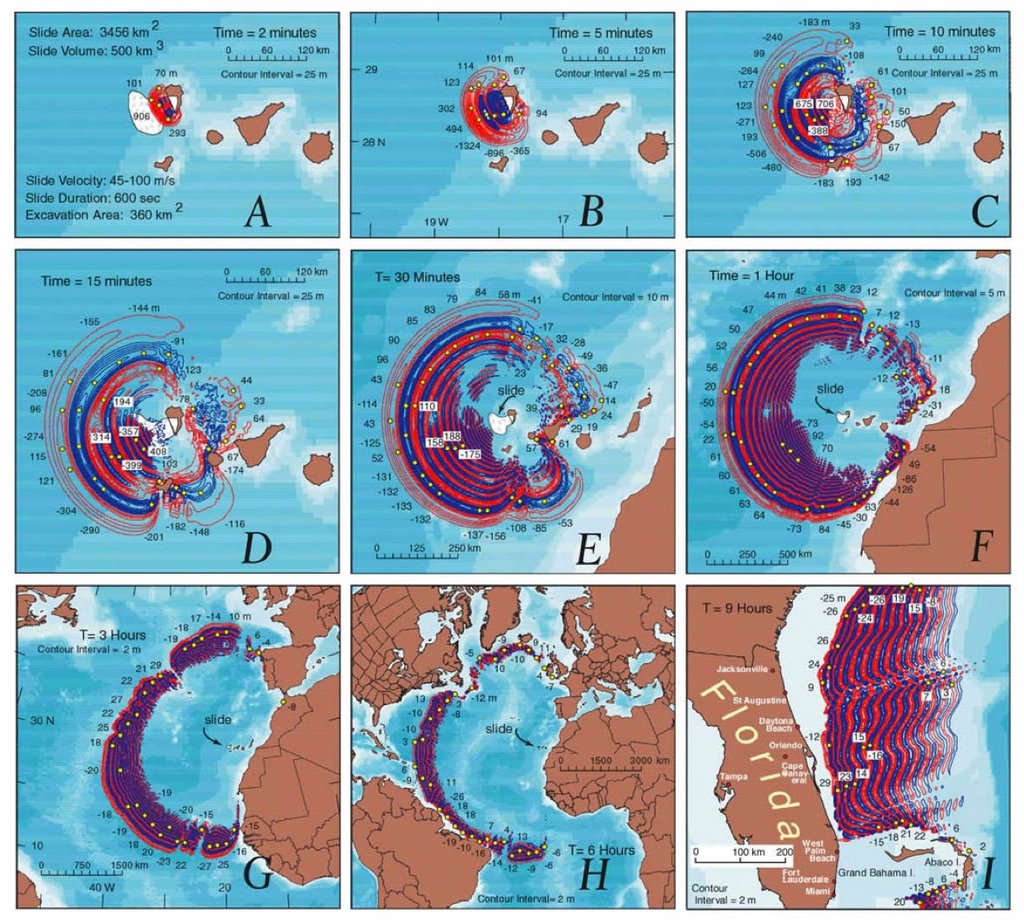
Cumbre Vieja volcano in the Canary Islands looks peaceful now. Undersea surveys have found a 400 cubic km landslide, the debris of a prehistoric eruption. Previous activity has caused the Western slope to come loose, creating a North-South fracture. Another large eruption would cause 500 cubic kilometres of mountain to crash into the sea. Dr. Simon Day and Steven Ward have modelled what would happen next.

The initial impact would create a water dome 900 meters high, collapsing and spreading like a stone in a giant pond. A massive tsunami would race across the Atlantic at nearly 800 km/hr. The coast of Morocco would be struck by waves 100 meters high. Waves up to 50 meters from crest to trough would strike the US East Coast. Water would inundate coasts from Britain to Brazil.

The Indian Ocean tsunami of 2004 produced waves up to 30 m high. Krakatoa's eruption in 1883 created 6 m waves, killing 30,000 people. The damage in New York City alone would make 9/11 look like a college prank. The Northeastern US is also vulnerable to earthquakes. As recently as 1925 a magnitude 7 quake struck the region. Unlike California or Hawaii, New York has never prepared for a major earthquake.

Before Einstein and Planck some scientists believed they knew everything about physics. Even today some will tell you that they have inventoried everything in the Universe. It is the height of folly to think we know everything in nature. Earthquakes, volcanoes and tsunamis could be the hiccoughs of a Black Hole less than a millimetre across. The Universe has power and mystery far beyond human understanding.

Labels: ,

Friday, April 09, 2010

A Visit to Mauna Kea


The highlight of stay on the Big Island is a trip to Mauna Kea's summit. We meet in the Stone House at the 9200 foot level. Nearby are the dormitories where we can sleep or get meals; noone is allowed to sleep at the summit. Mauna Kea is one of the world's best observing sites due to its altitude, lack of humidity, and the clean air rolling in from the Pacific trademwinds.

The twin domes of the Keck Telescope, flanked by the Subaru telescope (left) and the NASA Infrared Telescope Facillty (right.) Mauna Kea is considered sacred by Hawaiians. One legend says that the summit is where sky and Earth pulled apart to create the heavens. Today Mauna Kea sports the world's premiere collection of telescopes. On the lower slopes Apollo astronauts once trained for the Moon.

The summit is 13,796 feet above sea level. Measured from its base on the ocean floor, this is the world's tallest mountain. Mauna Kea is a dormant volcano, another product of Earth's internal heat. Possibly that heat is generated by a tiny Black Hole at Earth's core. While
astronomers search the skies for Black Holes, they should also consider what could be beneath their feet. A tiny Black Hole would have pulled dust from Space to start the birth of a planet. Like our Hawaiian legend, the Black Hole would have separated Earth from the heavens. The Big Island is indeed a place where Earth and sky are connected.

Celestial Spider hosts the new Carnival of Space!

Labels: ,

Wednesday, April 07, 2010

Kealakekua and Tsunamis


Italy's National Institute of Geophysics and Volcanology has warned that Europe's largest undersea volcano, Marsili, could collapse at any time. Enzo Boschi, President of the NIGV, warned that Marsili's fragile walls could collapse without warning. The resulting tsunami would engulf the Italian coast. Marsili is located 150 kilometres South of Naples, and its crater is only 450 meters below the Mediterranean surface.

Above is a favourite place, Kelakekua Bay on the Big Island. It was the site of great tragedy when Captain Cook's blood was spilled in 1779. Today it has some of the best snorkelling reefs on the island. Spinner dolphins are often seen in the bay too.

The steep cliff on the far side of the bay marks where a 30-km chunk of the shoreline broke free 120,000 years ago and plunged into the sea. The resulting tsunami completely submerged the island of Kaho'olawe, 1427 feet high! The wave continued and nearly inundated the island of Lanai. Today on Lanai you can still find chunks of coral deposited at the 1000-foot level.

Cumbre Vieja volcano in the Canary Islands looks peaceful now. Undersea surveys have found a 400 cubic km landslide, the debris of a prehistoric eruption. Previous activity has caused the Western slope to come loose, creating a North-South fracture. Another large eruption would cause 500 cubic kilometres of mountain to crash into the sea. Dr. Simon Day and Steven Ward have modelled what would happen next.

The initial impact would create a water dome 900 meters high, collapsing and spreading like a stone in a giant pond. A massive tsunami would race across the Atlantic at nearly 800 km/hr. The coast of Morocco would be struck by waves 100 meters high. Waves up to 50 meters from crest to trough would strike the US East Coast. Water would inundate coasts from Britain to Brazil.

The Indian Ocean tsunami of 2004 produced waves up to 30 m high. Krakatoa's eruption in 1883 created 6 m waves, killing 30,000 people. The damage in New York City alone would make 9/11 look like a college prank. The Northeastern US is also vulnerable to earthquakes. As recently as 1925 a magnitude 7 quake struck the region. Unlike California or Hawaii, New York has never prepared for a major earthquake.

Before Einstein and Planck some scientists believed they knew everything about physics. Even today some will tell you that they have inventoried everything in the Universe. It is the height of folly to think we know everything in nature. Earthquakes, volcanoes and tsunamis could be the hiccoughs of a Black Hole less than a millimetre across. The Universe has power and mystery far beyond human understanding.

Labels:

Thursday, April 01, 2010

A Volcano Erupts


Mark Twain in 1866 hiked through Kilauea Crater and wrote about a lake of molten lava:

"It was like gazing at the sun at noon-day, except that the glare was not quite so white. At unequal distances all around the shores of the lake were nearly white-hot chimneys or hollow drums of lava, four or five feet high, and up through them were bursting gorgeous sprays of lava-gouts and gem spangles, some white, some red and some golden--a ceaseless bombardment, and one that fascinated the eye with its unapproachable splendor."

Until 2008 anyone could walk here, the crater floor. In the background is the smaller Halema'uma'u crater. Until recently one could eat lunch or spend the night at Volcano House on the rim of Kilauea Crater. Today no one is allowed on the crater floor, Volcano House is shut down, and Halema'uma'u Crater looks like this.

The crater has again become a lava lake, and steam isues constantly. At night an orange glow is visible from Jaggar Museum.

Former location of the Kalapana subdivision, now covered with miles of lava. In the background clouds ominously hover over Kilauea.

Humans fear them, but volcanoes are not all fire and destruction. Their heat created the Hawaiian islands, along with wonders like the Punaluu black sand beach. The continents were formed and transported by Earth's internal heat. Life on Earth may have began in undersea vents warmed by volcanic heat.

Humans fear Black Holes, but our planet and solar system may be the result of a tiny Black Hole drawing dust to it. Without a Black Hole, scientists have difficulty explaining how Earth formed at all. Though still smaller than a grain of black sand, it continues to produce the heat that forms islands and continents. The magnetic field produced by the Black Hole's rotation guides compass needles and protects Earth from harmful radiation.

Here at Punaluu evidence for the Black Hole is right at our feet. The volcanic sand with its high iron content must originate deep within the Earth, from the hot plume that built the islands. Old theories of "radioactive decay" would fill these sands with radionucleides, but few such elements are present. Radioactive elements are only common in Earth's crust, where they arrived via meteorites. The core's heat must originate with something even more powerful than nuclear radiation, the heat from a tiny Black Hole.

Two fearsome phenomena may be related, the volcano's heat originating in a Black Hole. Both are subjects of fear and wonder. Humans may speculate for centuries before figuring out the relation. They are both part of the unapproachable splendor that Mark Twain marvelled at.

Labels: , ,

Wednesday, March 31, 2010

Pearl


More photos from Pearl Harbor: Within sight of Missouri is the Submarine Force Museum. Here we can walk the decks of USS Bowfin, a WW2 fleet submarine.

Torpedo room of USS Bowfin.

On Ford Island in the middle of Pearl Harbor is the new Pacific Aviation Museum. Its first phase includes WW2 aircraft like this Japanese Zero.

A B-25 bomber like those which participated in the "Doolittle Raid" over Tokyo.

Pearl Harbor was named for the pearls that were once harvested here. One grain of sand caught within an oyster is enough to start a pearl forming. Our planet Earth may have began with a Black Hole even smaller than a grain of sand. Many billions of such tiny singularities were created in the Big Bang. When our solar system was no more than a diffuse cloud, a number of small Black Holes collided with the gas.

The matter particles of the pre-solar disk were too tiny to form planets on their own, but a Black Hole drew matter like a magnet. Some gas fell into the singularity, causing it to glow red hot. Outward pressure from radiation prevented more gas from being sucked up. Dust gathered around the singularity until it formed a globe of matter with a hot centre. This was the birth of a planet.

Still no larger than a grain of sand, the Black Hole is still at Earth's centre. It consumes no more matter than a human eats, barely a ton per year. This small amount is more than replenished by matter falling to Earth via meteorites. The Black Hole rotates within Earth, dragging charged particles around it to generate a magnetic field. The heat produced by the singularity keeps Earth's core hot. This heat formed continents and continues to create the Hawaiian Islands.

NEXT: On the Big Island, we see results of the Black Hole's heat.

Labels: ,

Monday, March 29, 2010

Missouri


Captain's chair on bridge of Battleship USS Missouri.

Missouri docked at her permanent home in Pearl Harbor, Oahu. On her decks the instrument of surrender was signed ending World War 2.

An unforgettable view from the bridge windows towards the USS Arizona Memorial. To protect against bombs and torpedoes, Missouri is armoured in steel plate more than 30centimetres thick in places.

The 16-inch gun turrets. Missouri and other Iowa-Class battleships carried 9 such giant rifles. They could each fire a 2700-pound shell 40 kilometres! Due to Earth's curvature a battleship can only fire as far as it can see, leaving the advantage to aeroplanes. For centuries ships with cannon dominated naval warfare.

Isaac Newton saw warships armed with cannon. He saw that the faster a cannonball is fired, the farther it travels. Newton deduced that a projectile moving fast enough would "fall" around the Earth's curve, becoming a satellite. The farther a satellite orbits from Earth, the slower its velocity. Newton surmised that the Moon's orbit followed the same law of gravitation.

If Newton were alive today he would see that particles of light (photons) appear to travel at the same velocity. He would also see evidence that Space/Time began at a tiny point, called a "Big Bang." As the Universe gets older, every point in Space/Time travels farther from that initial singularity.

Perhaps Newton would deduce that gravitation affects all particles, even those of light. Just as satellites circle the Earth, he might surmise that photons are locked in orbit around a "Big Bang." As light particles move farther in Space/Time from the Big Bang, their velocity must also slow.

GM=tc^3. Where G is Newton's gravitational constant, M and t are mass and age of the Universe. As time t increases, speed of light c is predicted to slow. Newton's laws continue to guide our spacecraft to the planets. The power of ideas lasts longer and travels much farther than a battleship's guns.

Labels: ,

Friday, March 26, 2010

Waves and Dukes


(From Waikiki, 2006)

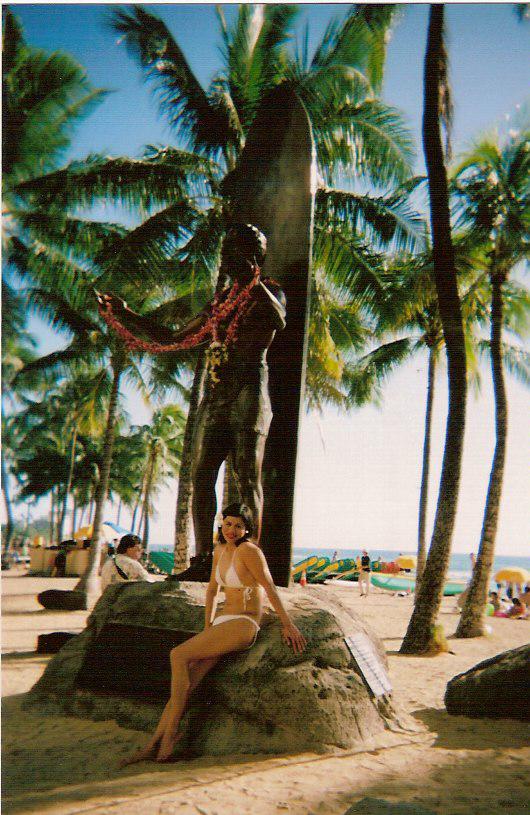
Duke Kahanamoku was an Olympic swimming champion and a hero to us islanders. He popularised our Hawaiian sport of surfing to the world. At age 20, in an amateur meet, he broke the world record for the 100-meter freestyle. This feat by an islander was so surprising that the athletic union didn't recognise it for years. He won Olympic medals for the US in 1912, 1920 and the Paris Olympics of 1924.

Between Olympics Duke Kahanamoku gave surfing displays around the world. His exhibition in Sydney on December 23, 1914 is regarded as the start of Australian surfing. A statue of Duke stands at Freshwater Beach north of Manly. Thanks to the Duke, Queensland's Coast is known as Surfer's Paradise. He worked as a film actor in Hollywood, like yours truly. While living in Newport Beach, he single-handedly rescued 8 people from a sinking boat using his board.

Future generations will wonder why this planet was called "Earth," since it is mostly covered by water. If one grew up on an island, it is obvious that we are surrounded by the sea. Pacific navigators colonised the islands from Asia to Hawaii in a process that took centuries. That is a natural model for exploring other solar systems.

As we have seen many times, waves are important to physics and astronomy. The imprint of waves in the CMB can determine whether inflation happened or a changing speed of light. Maxwell's equations show that visible light, infrared and gamma radiation are all electromagnetic waves. Contributor Nigel has explored the waves in nuclear explosions. Waves touch us in sound and in the tides. The effect of tides on the Moon is one more clue that c has changed.

Because sound waves travel in air and water waves through water, it was long assumed that light travelled through some medium. Since light travels throughout the Universe, this ether was presumed to be invisible and fill all Space, just like "dark energy." Maxwell himself believed that Earth travelled through ether like a ship through water. The inferrence of an invisible ether lasted until Einstein introduced Special Relativity.

In 1924, while Duke Kahanamoku was competing in the Paris Olympics, another duke was making waves nearby. A graduate student in Paris named Duc Louis de Broglie suggested that electrons also took the form of waves. Their wavelength is given by the relation h/p. De Broglie published this simple relation in an extremely short PhD thesis.

Like an equation about light, Duc De Broglie's thesis was short but revolutionary. His thesis would have been rejected outright except for the support of Albert Einstein, who recommended De Broglie for a PhD. Einstein also nominated De Broglie for the Nobel Prize in 1929--nice to have friends like that. Like Duke Kahanamoku's 100-meter record, Duc de Broglie's achievement almost went unrecognised. Thanks to supporters like Einstein, we enjoy both surfing and De Broglie waves.

Labels: ,

Wednesday, March 24, 2010

Rewards


Last Tuesday March 16, 2010 at the Sheraton Waikiki: Geologist and Moonwalker Harrison Schmitt (in an Aloha shirt) receives a medal from the American Society of Civil Engineering. The ASCE Earth/Space Conference was attended by engineers and scientists from across the Pacific, energized by ideas of engineering in Space.

Last night March 23, 2010 at Johnson Space Center in Houston: We greet the crew of STS-130. Their mission installed a Node and viewing Cupola to the International Space Station.

Equally important, Lockheed contractor Blake Dumesnil was named winner of the Shuttle patch design contest. His patch is symbolic of the entire Shuttle program.

The view from my room at the Sheraton Waikiki. Also Tuesday I delivered a talk on lunar research to the same international audience. That girl with ideas about light will never amount to anything, will she? More pictures from Hawaii coming soon!

Labels: , ,

Friday, August 21, 2009

Happy Hawaii Five-Oh!

This is a year of many anniversaries: 500 for Galileo's telescope, 40 for the first Moon landing and even the X-15 program. Lest we forget, on August 21, 1959 Hawaii was admitted as the 50th US State!

Labels:

Saturday, September 13, 2008

Hawaiian Solar System


Concerns and best wishes to friends in the Houston - Clear Lake area.

Mauna Kea's summit seen from my plane. The Islands often seem like little worlds, each with its own unique character. The Hawaiian solar system is central in the vast Space of the Pacific. Polynesian navigators settled the Pacific island by island in a process that took centuries. Future humans could settle the Galaxy in the same way.

Friday the national Space Society and John C. Mankins (expert on Space Solar Power) announced the first long-distance transmission of solar energy. The project transmitted power between antennas on two Hawaiian islands 148 km apart. This is similiar to the distance from low Earth orbit, though far from the 36,000 km geosynchronous orbit. Earlier this year we heard Colonel "Coyote" Smith announce a project to transmit power from orbit. The dream of limitless clean energy from Space may finally be moving forward.

Orbital Hub hosts the new Carnival of Space!

Labels: ,

Tuesday, April 08, 2008

The Eruption Continues


Halema'uma'u Crater April 8, 2008

The eruption of Halema'uma'u crater on Kilauea forced the evacuation of the surrounding settlements: Volcano House, the Kilauea Military camp and Volcano Charter School. Evacuation was recommended for the surrounding communities. Fortunately these towns are uphill from the crater and not in danger from lava flow. The greatest dangers are from sulfur dioxide and ash. Humans have long wondered what keeps Earth's core hot. The answer may lie in cosmology and a little Black Hole.

Labels: ,

Sunday, March 30, 2008

Eruptions


Halema'uma'u Crater March 29, 2008

Halema'uma'u crater has been erupting since March 19. On March 24 the fumes were joined by ash and molten particles. Halema'uma'u is located on the floor of Kilauea caldera--for years we children ould safely walk to the edge. Ash has been reported as far away as South Point (southernmost spot in the 50 states). Part of Chain of Craters Road is closed because of the hazard. The vent at Pu'u O'o has been erupting for years. Change is inevitable, even in the speed of light. Without Earth's internal heat our islands and continents would not have formed.

Cassini's close encounter with Enceladus was marred by a faulty sensor. Nevertheless, scientists have found traces of organic molecules in Enceladus' vapour plume. They have also found higher temperatures than were found before. The thermal view below of the South Pole shows heat emanating from the tiger stripe features. The interior likely has temperatures suitable for liquid water and life. For life to evolve so far from the Sun, internal heat would have to be maintained over billions of years. This is a good place to search for a Black Hole.

We have found organic molecules and possible internal heat on Titan, also considered a possible home of life. We grew up learning that life depends on a Sun. Inner heat of worlds may be more important to life than previously thought. Someday we may find that Black Holes and life are connected.

Check out the new Carnival of Space!

Labels: , ,

Monday, March 17, 2008

Eclipse


Shadow In Shadow from Alex Mukensnable on Vimeo.
Like a slowly forming neural net, the links continue to march on! Scienceblogs was kind enough to notice the 3.14 post for A Blog Around the Clock.

While some of us were tied up in meetings at Marina Del Rey, Alex Mukensnable atop Mauna Kea made a time-lapse film (with music) of February 20's eclipse. Being so far West, Hawaii only caught a portion of the event after sunset. (Maximum coverage was 4:32 PM local time.) The mountain's shadow on the clouds is always beautiful to behold.

Labels: ,

Monday, November 19, 2007

Volcano


Continuing the location search for a Science Hostel: With its telescopes and dominating location, Mauna Kea immediately draws attention. Astronomers have housing at Hale Pohaku near the 2800 meter elevation. Because of the altitude, no one is allowed to sleep on Mauna Kea's summit. Nearby a visitor information centre hosts astronomy lectures and outdoor star parties. Stargazing tours take astronomy buffs for brief visits to the summit--it would be wonderful if they had a place to spend the night.

HIKING AND SNOW: The mountain has many varied hiking trails, but watch out for the altitude. Every Winter enough snow falls on the summit for snowboarding and some skiing.

DISADVANTAGES: Difficult to reach unless you have 4WD. All water must be shipped in. The biggest obstacle to a Hostel is that most of the land is public. Keck Telescope headquarters is some distance away in Kamuela. Perhaps on the mountain's slopes an astronomy inn will someday see first light.

Enshrouded in fog and overgrown with ferns, this forest looks like the Pacific Northwest. This photo was taken atop a live volcano in the middle of the Pacific. Volcano Village is perched just a short hike from the edge of Kilauea Crater. Within walking distance are the Volcano Art Center, post office, grocery store, laundromat, hardware store and 3 restaurants. Penniless scientists can reach here via the Mele bus from Hilo.

Don't worry about lava--this mature forest that has not seen Madame Pele for centuries. The present centre of eruptions is at Pu'u O'o, Southeast of the town and slowly moving further away. Even if Kilauaea were to erupt, the village is uphill from the crater and lava flows down. Unknown to most of the world, the Volcano Village is a natural location for a hostel or shared home.

HIKING AND SNOW: Of all places mentioned, Volcano has the greatest variety for hiking. In a day's walk one could see anything from the floor of Kilauea Crater to endless rain forest. The nearest snow is on Mauna Kea.

DISADVANTAGES: The nearest snow is on Mauna Kea, as are most of the telescopes.

Though fog makes this a poor site for observing the sky, it may have a lot to do with the Big Bang. Kilauea volcano is powered by Earth's internal heat, which also creates continents and islands. Internal heat, magnetic field and even the riddle of Earth's formation could all be explained by a tiny Black Hole. Tiny singularities would have been created in the immense pressures near the Big Bang. In the primordial Solar System, Earth would have formed around this little hole like a pearl around a grain of sand. Our Solar System, planet and Volcano Village may owe their existence to a relic of the Big Bang.

Labels:

Saturday, October 20, 2007

Mars, Water and Life


The Spirit and Opportunity rovers were designed to last just three months. Having survived a huge dust storm, they are now projected to operate until 2009. Spirit suffered a locked wheel, which may have led to a big discovery! Humans could find much more walking on Mars, but that may not happen until 2037.

Presently Opportunity is slowly descending into Victoria Crater. The crater is 70 meters deep and nearly a kilometer wide. Rok layers within suggest sedimentation and ancient water. On the far side of the world, Spirit is exploring an region of basalt and ancient vulcanism.

Though our explorations have been limited to a few tiny probes, Mars continues to surprise. From time to time photos show tantalizing features of water flow that seem to come and go. A flow will be there in one photo and gone in the next. Scientists suggest that ice deposits erupt briefly into liquid before freezing again. Some inner source of heat may be required to melt the ice.

From the Toronto Star: Canadian researchers claim the strongest evidence yet for water on Mars. When one of Spirit's wheels became stuck, it churned up a white layer just beneath the surface. Careful analysis by the alpha particle X-ray spectrometer revealed that this salty layer may be 18 percent water. The white layer was seen in four separate sites in the Columbia hills, suggsting that it is quite common. Professor Iain Campbell of the University of Guelph was assisted by physicist Joanne O'Meara with students Mary Lee and Christianne Mallett.

Like characters in a Monty Python sketch, Mars volcanoes may not be dead, just sleeping. NASA-funded scientists have been comparing features on the Tharsis bulge (above) with shield volcanoes on our Big Island of Hawaii. Though no volcanic activity has been directly observed on Mars, a lack of impact craters suggests that the terrain is relatively new. Ascraeous Mons, Northernmost of the chain, has the most lava tubes and appears to be youngest. Tharsis volcanoes are EXTREMELY similiar to our Big Island. NASA Press Release

The Hawaiian Islands began far to our Northwest, with islands like Midway that have since subsided into atolls. The most recent activity in the Big Island is in our Southeast. The Big Island is less than a million years old, and still very active. Airborne eruptions (at least this week) are limited to a small vent at Pu'u O'o. Another big eruption could start at any time. Farther to sea the new island of Lo'ihi is already building and will emerge in a few thousand years.

Subsurface heat might explain the brief appearance of flow formations on the Martian surface. Just as volcanic eruptions fill Earth's atmosphere with greenhouse gases, volcanoes on Mars may resupply the thin CO2 atmosphere. If Mars began with a tiny Black Hole, it could still be giving off Hawking radiation. The Black Hole could still be inside Mars.

Paul Davies is author of many books and one of Australia's best-known scientists. Today he makes a home at Arizona State University and continues to study the Universe. In the latest issue of Cosmos magazine, Davies again wonders whether life on Earth originated on Mars. We have many examples of Martian meteorites that made the journey to Earth. Mars is "uphill" in the Sun's gravity well. The chemicals of life originated even further away, in explosions of supernovae. We and all life on Earth could be Martians! Exploration of Mars may lead to discoveries that will shed light on human existence.

Labels: ,

Monday, August 27, 2007

Quantum Geckos


This cute photo makes one hungry for papaya! More fond memories are of the beach house on Hanalei Bay, the picture window facing the ocean and geckos that climbed the glass every night. As children we learned that geckos are friends who eat mosquitoes and other pests. From the time of Aristotle, scientists have wondered how geckos can stick to perfectly smooth surfaces. Only in 2002 did this PNAS paper tell of a solution. The gecko's secret lies in the realm of quantum mechanics, virtual particles and the van der Waals effect.

Geckos in the Escher drawing occupy both positive and negative space. Quantum mechanics theorises that apparently empty Space is a sea of virtual particles constantly winking in and out of existence. If two surfaces are extremely close together, quantum particles have no room to pop in. This creates a quantum vacuum, allowing the surfaces to stick. Gecko toes are covered with millions of bristles, each of which is covered with thousands of microscopic hairs. This allows a gecko to get extremely close to any surface, and break free by retracting the hairs.

Researchers have attempted to mimic the gecko's ability to create super-strong adhesives. So far they have difficulty producing gecko-derived adhesive in a usable quantity. Makers of carbon nanotubes face a similiar challenge if they are to build Space elevators. The gecko made use of quantum mechanics long before humans figured it out!

The protons and electrons that we are made of began as virtual particles. Today they pop in and just as quickly pop out, because the Universe has reached a stable density. Near the Big Bang the Universe had not reached this density. Virtual particles could pop in and stay.

Suppose that the Universe is spherical with a radius given by:

R = ct

The volume of this 4-dimensional Riemann sphere is given by :
V = 2 ($\pi$^2) (R^3)

We know that GM = tc^3. For an initial mass M, density $\rho_i$ is just M/V:

$\rho_i$ = M/V = (2 $\pi$^2 G t^2 )^{-1}

But the stable density $\rho_f$ after matter has formed is:

$\rho_f$ = ($6 \pi G$t^2)^{-1}

Difference between $\rho_i$ before matter and $\rho_f$ after matter formation is precisely 4.507034%. This unique prediction of Theory has been verified by the Wilkinson Microwave Anisotropy Probe. Density allows us to check the geometry of the Universe. If it had a different shape, the percentage of baryonic matter would be different.

Why have more people not heard about this? While it is easy to write about strings or "dark energy," theories predicting a changing speed of light are difficult to even publish. Nevertheless, another paper is shortly appearing in a journal and the word is spreading exponentially. The happiest one of all will still be that gecko getting his papaya!

Labels: ,

Thursday, July 05, 2007

Octosquid


This strange creature, nicknamed the Octosquid, was captured last week off the Big Island's Keahole Point. It has eight tentacles and an octopus head, but with a squidlike mantle. It was caught in a pipeline belonging to the Natural Energy Laboratory of Hawaii. The pipeline, 3000 feet deep, gathers deep sea water for the Scienceand Technology Park in Kailua-Kona. The ocean floor is mysterious as the surface of the Moon. At that depth live many strange life forms humans know nothing about.

Labels:

Locations of visitors to this page