Monday, March 19, 2012
I have started a new project on Kickstarter, to spread models of the Universe. You've seen globes and models of the Moon, planets and solar system. For the cost of a latte, you will have a downloadable model of the entire Universe sitting on your desktop! The model also includes the stars and constellations of the hemisphere. Any proceeds will go toward publication costs and registration at an international conference I'm invited to. Check it out and tell all your friends!
Saturday, April 23, 2011
Hot Enough 2

McDonald Observatory in Texas on April 17. The big dome is the 9.2 meter Hobby-Eberly telescope. Suffering from its own drought, Texas is experiencing scattered wildfires from East to West. The Rockhouse fire covers 202,000 acres. Eighteen separate fires together cover about 1 million acres. At this writing, McDonald Observatory seems to have escaped danger.
Observatories tend to be built on isolated mountaintops, which can be prime locations for fires. In August 2009 an arson fire came within 500 meters of California's famous Mount Wilson Observatory. The Station Fire did consume two firefighters and about 160,000 acres. In May 2007, Griffith Park Above the Fire, another California fire came very close to Los Angeles' Griffith Observatory. In January 2003 a brushfire devastated Australia's Mount Stromlo observatory, wiping out 6 of the telescopes. Mount Stromlo is still rebuilding.
Saturday, November 20, 2010
Top 50!
One more Florida photo, Spaceship Earth at Disney's EPCOT.
Guide to Online Schools has released a list of:
50 Astounding Astronomy Blogs.
"Astronomy is the science that asks the eternal "big-picture" questions, which is precisely what makes it so fascinating. Its discoveries and theories about the origin, organization, and ultimate fate of the universe appeal to our innate desire to learn about what goes on around us, but they are also some of the most difficult questions to answer. We've searched the web to bring you fifty astounding blogs that capture the mystery and beauty of the cosmos."
By complete surprise a little blog called "GM=tc^3" has made the list! Thank you, Guide to Online Schools! You are the future!
This year also saw mention from Portugal, in the AstroPT Blog
"GM=tc^3: Uma nova teoria, sobre a velocidade da luz estar a abrandar (que dirá o João Magueijo?), e que poderá explicar os desvios para o vermelho, e sobretudo a energia negra.
Parece-me é que ainda não foi avaliada pela comunidade científica…"
In my bad Portuguese this begins as, "GM=tc^3: A new theory, in which the speed of light is slowing..."
Thank you AstroPT! An equation has the same meaning in all languages. Once it is discovered it cannot be killed or suppressed. GM=tc^3 will strive to be worthy of these honours.
Labels: astronomy
Saturday, November 13, 2010
What a Tangled Webb We Weave
This blog has chronicled various ill-starred projects to search for fictional "dark energy." These were given names like SNAP and DESTINY, planned as Space telescopes up to 2.0 m diameter. After much disagreement, they were recently folded together into a 1.5 m telescope called WFIRST. This combined project was given highest priority in a Decadal Survey of the National. Research Council. WFIRST would search for extrasolar planets and, as a secondary goal, "dark energy." Even the reduced project may be done in by this:

The James Webb Space Telescope, NASA's flagship astrophysics mission, is years behind schedule and will cost at least 1.5 billion more than its current 5 billion dollar budget. To meet a launch date of 2015 JWST needs an immediate 400 million. In today's budget environment, NASA can not spare such a sum. Delays to JWST will impact other missions, especially WFIRST.
Additional budget pressure comes from the Stratospheric Observatory For Infared Astronomy. SOFIA, a giant telescope mounted in a 747SP, is also far over schedule and budget. JWST, SOFIA and the Hubble Space Telescope consume most of NASA's astrophysics budget. Their huge costs are causing delay or cancellation of other projects. Despite the high priority given WFIRST, it will not fly in this decade, if ever.
The hypothetical acceleration of "dark energy" is caused by something so simple that physicists have overlooked it. Redshifts are proportional to the speed of light c. Rather than the Universe accelerating, we have observed the speed of light slowing down. Long before scientists even get a chance to find their "dark energy," evidence will show a "c change" in physics.

The James Webb Space Telescope, NASA's flagship astrophysics mission, is years behind schedule and will cost at least 1.5 billion more than its current 5 billion dollar budget. To meet a launch date of 2015 JWST needs an immediate 400 million. In today's budget environment, NASA can not spare such a sum. Delays to JWST will impact other missions, especially WFIRST.
Additional budget pressure comes from the Stratospheric Observatory For Infared Astronomy. SOFIA, a giant telescope mounted in a 747SP, is also far over schedule and budget. JWST, SOFIA and the Hubble Space Telescope consume most of NASA's astrophysics budget. Their huge costs are causing delay or cancellation of other projects. Despite the high priority given WFIRST, it will not fly in this decade, if ever.
The hypothetical acceleration of "dark energy" is caused by something so simple that physicists have overlooked it. Redshifts are proportional to the speed of light c. Rather than the Universe accelerating, we have observed the speed of light slowing down. Long before scientists even get a chance to find their "dark energy," evidence will show a "c change" in physics.
Labels: astronomy
Friday, April 09, 2010
A Visit to Mauna Kea

The highlight of stay on the Big Island is a trip to Mauna Kea's summit. We meet in the Stone House at the 9200 foot level. Nearby are the dormitories where we can sleep or get meals; noone is allowed to sleep at the summit. Mauna Kea is one of the world's best observing sites due to its altitude, lack of humidity, and the clean air rolling in from the Pacific trademwinds.

The twin domes of the Keck Telescope, flanked by the Subaru telescope (left) and the NASA Infrared Telescope Facillty (right.) Mauna Kea is considered sacred by Hawaiians. One legend says that the summit is where sky and Earth pulled apart to create the heavens. Today Mauna Kea sports the world's premiere collection of telescopes. On the lower slopes Apollo astronauts once trained for the Moon.

The summit is 13,796 feet above sea level. Measured from its base on the ocean floor, this is the world's tallest mountain. Mauna Kea is a dormant volcano, another product of Earth's internal heat. Possibly that heat is generated by a tiny Black Hole at Earth's core. While
astronomers search the skies for Black Holes, they should also consider what could be beneath their feet. A tiny Black Hole would have pulled dust from Space to start the birth of a planet. Like our Hawaiian legend, the Black Hole would have separated Earth from the heavens. The Big Island is indeed a place where Earth and sky are connected.
Celestial Spider hosts the new Carnival of Space!
Monday, August 10, 2009
Rio In the Light

As promised, here are some photos from Rio de Janeiro. Last week was very busy, but Friday afternoon we visited Rio's observatory.

Forte Copacabana and its guns occupy a commanding position overlooking the beach. If someone looks tired, it is from hiking here from the Copacabana Palace Hotel.

These sand sculptures on Copacabana seemed an appropriate place to wear the native clothing.

The sun sets over Copacabana and Sugar Loaf Mountain..
Labels: astronomy, rio de janeiro
Thursday, August 06, 2009
Extreme Scope

From the IAU assembly in Rio de Janeiro: This model of the Extremely Large Telescope (ELT) is impressive even in miniature. Many concepts were studied, notably an Overwhelmingly Large telescope (OWL) with a mirror 100 metres in diameter! Final approval is expected next year for first light in 2018.
Labels: astronomy
Wednesday, August 05, 2009
Rio!

View out window of Sulamerica Convention Centre.
General Assembly of the International Astronomical Union happens every 3 years. Among other issues, the IAU gives objects their official names. The last meeting in 2006 was infamous for demoting Pluto to minor planet status. For the next 2 weeks IAU is meeting in Rio de Janeiro. More photos coming soon!
In this sunny place, there are virtually no talks on "dark energy." That is largely a physicists' supposition, not of much interest to astronomers. Emphasis on "DE" has threatened funding for promising astronomical projects like Constellation-X. However, IAU is devoting 3 whole days to asking:
Are the Fundamental Constants Changing With Space/Time?
Bravo to Kea for reporting in The Imperial Force, a public debate at Imperial College between Oxford's Subir Sarkar abd a Dark Side apprentice. Subir gave several very convincing arguments that DE doesn't exist. At the end of the discussion the audience was informally polled as to whether DE exists. Subir won by an overwhelming margin. Among astronomers and the public, "dark energy" is starting to lose popularity.

Labels: astronomy, cosmology, speed of light
Monday, June 01, 2009
Another Voice
Nige reminds us of the work by Richard Lieu at Univeristy of Alabama. Lieu has been another voice crying out in the wilderness, pointing out inconsistencies in mainstream science. He helped organise "Outstanding Questions for the Standard Cosmological Model," a conference (funded by the NSF) in London which this writer was unfortunately late for. Nige agrees on many things, including the sad incompetence of the local government.
Lieu's 2007 paper was entitled LCDM cosmology: how much suppression of credible evidence, and does the model really lead its competitors, using all evidence? His conclusions:
"Cosmologists should not pretend to be mainstream physicists, because there is only one irreproducible Universe and control experiments are impossible. The claim to overwhelming evidence in support of dark energy and dark matter is an act of exaggeration which involves heavy selection of evidence and an inconsiderate attitude towards alternative models with fewer (or no) dark components. When all evidence are taken into account, it is by no means clear that LCDM wins by such leaps and bounds.
"Thus I do not see the wisdom of funding agencies in planning such ambitious and expensive programs to perform dark energy research, to the detriment of other fields of astronomy, as though cosmology has now become a branch of physics, which it will never be. These programs all have the common starting point that dark energy is really out there - no question about it. I hope the present article demonstrated the contrary."
Lieu measures the hodgepodge "LCDM" comsology with some alternatives you might not have heard about--from T. Shanks (2007), Subir Sarkar and Alain Blanchard (2003). These little-known cosmologies use the Einstein-de Sitter model where Omega = 1, and match just as many observations. Their main failing is not matching supernova data, for which the "standard model" adds the fudge factor of "dark energy."
Mainstream science and press promotes a hodgepodge model Through papers and conferences, word is getting out that there is Trouble with Physics. Alternative models explain as many observations as the mainstream, except for supernovae. All these models need is a changing speed of light.
UPDATE: As this is published, we have word that Home Secretary "Jackboot Jacqui" Smith is finally stepping down. Was it the Orweellian monitoring of cel phone calls and internet traffic? The ID scheme that would cost each citizen 60 pounds on top of the billions for implementing it? Charging a second home to the taxpayer while living with her sister? Making her husband a paid assistant? Said husband watching dirty movies at home alone and charging the taxpayer? Her giving him a 400 dollar iPhone and charging that too? She will shortly stand for re-election in her home district, though she is not popular enough to get elected dog-catcher. This relates to science in that dictatorship allows mediocrity to reach the top.
Lieu's 2007 paper was entitled LCDM cosmology: how much suppression of credible evidence, and does the model really lead its competitors, using all evidence? His conclusions:
"Cosmologists should not pretend to be mainstream physicists, because there is only one irreproducible Universe and control experiments are impossible. The claim to overwhelming evidence in support of dark energy and dark matter is an act of exaggeration which involves heavy selection of evidence and an inconsiderate attitude towards alternative models with fewer (or no) dark components. When all evidence are taken into account, it is by no means clear that LCDM wins by such leaps and bounds.
"Thus I do not see the wisdom of funding agencies in planning such ambitious and expensive programs to perform dark energy research, to the detriment of other fields of astronomy, as though cosmology has now become a branch of physics, which it will never be. These programs all have the common starting point that dark energy is really out there - no question about it. I hope the present article demonstrated the contrary."
Lieu measures the hodgepodge "LCDM" comsology with some alternatives you might not have heard about--from T. Shanks (2007), Subir Sarkar and Alain Blanchard (2003). These little-known cosmologies use the Einstein-de Sitter model where Omega = 1, and match just as many observations. Their main failing is not matching supernova data, for which the "standard model" adds the fudge factor of "dark energy."
Mainstream science and press promotes a hodgepodge model Through papers and conferences, word is getting out that there is Trouble with Physics. Alternative models explain as many observations as the mainstream, except for supernovae. All these models need is a changing speed of light.
UPDATE: As this is published, we have word that Home Secretary "Jackboot Jacqui" Smith is finally stepping down. Was it the Orweellian monitoring of cel phone calls and internet traffic? The ID scheme that would cost each citizen 60 pounds on top of the billions for implementing it? Charging a second home to the taxpayer while living with her sister? Making her husband a paid assistant? Said husband watching dirty movies at home alone and charging the taxpayer? Her giving him a 400 dollar iPhone and charging that too? She will shortly stand for re-election in her home district, though she is not popular enough to get elected dog-catcher. This relates to science in that dictatorship allows mediocrity to reach the top.
Labels: astronomy, cosmology, speed of light
Sunday, October 12, 2008
Hooray for Bad Astronomy
Comments have been sparse lately, but yet another discussion thread has appeared on the Bad Astronomy/Universe Today forum. Non-members can not leave comments there, but let us hope that this and other discussions stay civil.
To answer one question: "von Riemann" is a pun in German, meaning that the theory is from Riemann. If Riemann has his own Universe, he deserves "von" in front of his name.
Here's a fun question: How much potential energy does your pen have? In physics class we learn Newton's formula:
Eu = -GMm/r
Where Eu is potential energy, M is the mass of a larger object, usually Earth. m is the pen's mass, and r is the distance between masses.
Usually we measure the pen's energy from Earth, but the pen has more potential from the Sun. The pen doesn't fall toward the Sun because it shares Earth's orbital velocity. The pen has even more potential from the galaxy and everything else in the Universe. The pen's true potential should be:
Eu = -$\Sigma$ GMm/r
The $\Sigma$ sums the potential from every other mass in the Universe! How do we solve this? Fortunately, on large scales the Universe is a spherical mass distribution. We can write:
Eu = -GMm/R
Here M is total mass of the Universe, and R is distance to the centre of that mass.
There is no centre in Space, for every bit resembles every other bit. There is a centre in time, what we call a "Big Bang." Near that centre, mass M occupied a tiny volume. Now these things are known:
R = ct
GM = tc^3
Eu = -GMm/R = -(tc^3)m/(ct)
Eu = -mc^2
Does anyone doubt this E = mc^2 business? When it was first written in 1905, few paid attention. A century later everyone has heard of this equation, even if they don't understand it.
To avoid confusion, we will call E the Einstein energy and rename Eu as U, the Newton energy:
E + U = 0
The total energy of the pen is just zero! That applies for any object, from the tiniest particle to the biggest Black Hole. The total energy of the Universe is zero! It's the ultimate free lunch, which has allowed it to evolve from a tiny point to the immensity we observe today.
Best wishes to Praedst and other contributors. Followers on the Bad Astronomy/Universe Today are welcome to leave their questions here.
UPDATE: Following Ethan's lead, they seem to have become stuck on the Oklo Reactor. Oklo did not measure c, but the fine-structure constant proportional to product hc. This product is also part of the photon energy hc/$\lambda$ and the Chandrasekhar mass. If c decreases with time, h must increase inversely. They may be about to miss the chance of linking quantum mechanics with Relativity and gaining scientific immortality. This has been dealt with before, see Constraining Theories of the Speed of Light.
To answer one question: "von Riemann" is a pun in German, meaning that the theory is from Riemann. If Riemann has his own Universe, he deserves "von" in front of his name.
Here's a fun question: How much potential energy does your pen have? In physics class we learn Newton's formula:
Eu = -GMm/r
Where Eu is potential energy, M is the mass of a larger object, usually Earth. m is the pen's mass, and r is the distance between masses.
Usually we measure the pen's energy from Earth, but the pen has more potential from the Sun. The pen doesn't fall toward the Sun because it shares Earth's orbital velocity. The pen has even more potential from the galaxy and everything else in the Universe. The pen's true potential should be:
Eu = -$\Sigma$ GMm/r
The $\Sigma$ sums the potential from every other mass in the Universe! How do we solve this? Fortunately, on large scales the Universe is a spherical mass distribution. We can write:
Eu = -GMm/R
Here M is total mass of the Universe, and R is distance to the centre of that mass.
There is no centre in Space, for every bit resembles every other bit. There is a centre in time, what we call a "Big Bang." Near that centre, mass M occupied a tiny volume. Now these things are known:
R = ct
GM = tc^3
Eu = -GMm/R = -(tc^3)m/(ct)
Eu = -mc^2
Does anyone doubt this E = mc^2 business? When it was first written in 1905, few paid attention. A century later everyone has heard of this equation, even if they don't understand it.
To avoid confusion, we will call E the Einstein energy and rename Eu as U, the Newton energy:
E + U = 0
The total energy of the pen is just zero! That applies for any object, from the tiniest particle to the biggest Black Hole. The total energy of the Universe is zero! It's the ultimate free lunch, which has allowed it to evolve from a tiny point to the immensity we observe today.
Best wishes to Praedst and other contributors. Followers on the Bad Astronomy/Universe Today are welcome to leave their questions here.
UPDATE: Following Ethan's lead, they seem to have become stuck on the Oklo Reactor. Oklo did not measure c, but the fine-structure constant proportional to product hc. This product is also part of the photon energy hc/$\lambda$ and the Chandrasekhar mass. If c decreases with time, h must increase inversely. They may be about to miss the chance of linking quantum mechanics with Relativity and gaining scientific immortality. This has been dealt with before, see Constraining Theories of the Speed of Light.
Wednesday, June 04, 2008
Astronomical Unit Changing?
The Lunar Laser Ranging Experiment from 1969 provided one more indicator that the speed of light is slowing to this day.
Tuesday's New York Times reported the dismal state of "dark energy" research. Even the revered Ed Witten is at a loss to figure it out. There is no compelling theory for DE, researchers can't even agree on a mission concept, and the amount NASA has budgeted for JDEM is barely half what would be needed. All it would measure is an "equation of state." With all this flailing about in the dark, the reputation of science is slowly eroding. "We are placing a large bet," admitted the Director of the Space Telescope Science Institute, "using our credibility as collateral that we as a community know what we are doing."
GM = tc^3. As age of Universe t increases. light slows down. This would affect the redshifts of distant supernovae, making the Universe appear to accelerate. This produces a precise fit to supernova observations. A child could figure it out, yet until recently talk of changing c would get reactions ranging from willful ignorance to sexist attacks. Publishing papers on a changing c is still quite difficult. Childishness can not stop a growing body of evidence.
There is yet another indicator that c is slowing. The astronomical unit is the distance from Earth to Sun. By using Earth's orbit as a baseline, astronomers use the AU in calculating the parallax distance to nearby stars. Accurate measurements of the AU affect all our measurements of distant objects, as does the speed of light. Recent experiments seem to indicate that the AU itself is growing!
By analyzing radio echoes from the planets, G.A. Krasinsky and V.A. Blumberg measured change in the AU at about 7 cm/yr (Note 1). Independently E.M. standish estimates the change as about 5 cm/yr (Note 2). These estimates are made from many measurements, so they are likely to vary. Unlike the Moon's drift from Earth, growth in the AU can not be explained by tidal effects.
If the speed of light us slowing, the time for radio waves to return would increase, making the AU appear to grow. Suppose we measured the AU directly by bouncing light rays off the Sun. We can't do that for obvious reasons, but we can determine the approximate size of the effect. We have:
GM = tc^3 where t is age of the Universe, about 14 Gyr
c(t) = (GM)^{1/3} t^{-1/3}
cdot/c = -1/3t = -1/(42 Gyr)
Multiplied by an AU of 149 million kilometers, that distance will appear to increase by:
-(149E9 meters)/(42 Gyr) = 3.5 m/yr
The AU should appear to grow by 3.5 m/yr. If the measured recession appears smaller, Earth could conceivably be moving closer to the Sun! That would be very logical, as many theories of the solar system state that planets should drift inward. Earth could be headed toward a very hot fate, which we are kept from realising by scientists' insistence that c is constant.
The hypothesis of a repulsive "dark energy" has led nowhere. Betting on it has eroded the reputation of science. Data from Type Ia supernovae, the Lunar Laser Ranging Experiment and "Faint Young Sun" also indicate that c has slowed at the rate GM = tc^3 predicts. Eventually the weight of evidence will be too big to ignore. In the meantime, making new discoveries is a daily joy.
Women of Space are saluted in the new Carnival of Space!
Notes:
[1] G.A. Krasinsky and V.A. Brumberg, "Secular increase of astronomical unit from analysis of the major planets motions, and its interpretation," Celest. Mech. & Dyn. Astron. 90:267, 2004.
[2] E.M. Standish, "The Astronomical Unit Now," in Transits of Venus: New Views of the Solar System and Galaxy, Proceedings IAU Colloquium No. 196, page 163. Cambridge University Press, Cambridge, 2005.
Labels: astronomy, speed of light
Tuesday, December 04, 2007
Grand Central
Ceiling of Main Concourse in Grand Central Terminal. Depicted on this vault are the ecliptic, celestial equator, Pisces, Triangulum, Ares, Taurus, Orion, Gemini and Cancer. Brighter stars are marked with electric lights. Legend has it that once a motorised Sun moved across that ecliptic. In a city where electric lights drown out the stars, this is a very pleasant diversion.
Once upon a time people thought that stars were fixed to an enormous vault rotating overhead. In some ways this was a useful assumption. The stars are so distant that their parallax is not easily noticed. In our neighbourhood one needs only their right ascension and declination. Many scientists, including this one, keep on the shelf a clear ball with stars drawn on the surface. Even for navigation in Earth, it is safe to treat the stars as if they were fixed to a sphere.
Sharp-eyed astronomers will notice that the constellations are depicted inside out. Inspired by medieval depictions, the artist chose to depict a celestial sphere as if seen from the outside. This is quite inaccurate, for we know that the stars are varying distances from Earth and one could never see such a view. Once again the clear ball on the shelf proves useful in deciphering this picture.
Holes in grillwork over the South windows allow sunlight to pass through, showing images of the Sun at our feet. This acts as a camera obscura, allowing one to track sunspots on the floor. One can even track the Sun's rotation from the sunspots. Galileo's observation of sunspots contradict old theories. It is a mistake to allow the assumption of a celestial sphere to become canon.
Once upon a time people thought that the speed of light was fixed, like the Earth. In some ways this was a useful assumption. The speed of light changes so slowly that the change is not easily noticed. In our neighbourhood in Space/Time one need only the present value of c. Many scientists, including this one, keep on the shelf a book where the speed of light is treated as a constant. Even for navigation in the solar system, it is safe to treat c as constant.
Holes in present understanding allow light to pass through, showing a changing c. Observations of high-redshift supernovae point to a past where values like c may not have been the same. We have reached the Moon and brought back rocks billions of years old, from a time when c was slightly different. Observations of the distant Universe contradict old theories. It is a mistake to allow the assumption of constant c to become canon.
Labels: astronomy, New York, speed of light
Tuesday, November 20, 2007
The Seven Sisters

The Pleiades star cluster, 460 light-years away, is one of the prettiest sights in the sky. The Seven Sisters Celaeno, Electra, Taygeta, Maia, Asterope, Merope and Alcyone are visible to the naked eye. Very sharp eyes can tell that Asterope 1 and Asterope 2 are 2 distinct stars. The two bright stars on the left are Atlas and Pleione, mythological parents to the Pleiades. The entire cluster contains over 1400 stars. These young blue stars are only a few hundred million years old, still in the process of forming solar systems.
Using the Gemini North telescope atop Mauna Kea and data from the Spitzer Space Telescope, astronomers may have found signs of planets forming in the Pleiades. Like many of today's discoveries, this was found by searching old data. In the Spitzer database astronomers found HD23514, a star very similiar to our Sun. Obscured by dust in the nebula, sunlike stars are not easy to see among the hot blue Seven sisters. Further infrared observations from Gemini North revealed a signature of hot dust particles. HD23514 seems to be surrounded by hundred of thousands of times more dust than our Sun. This signature is interpreted as a planetary system in process of formation.
Though astronomers have now found many planets in other solar systems, they are still not sure how planets start forming. Though there is much evidence that planets condense from nebulae, rocks colliding at orbital velocity will not accrete into planets. How infant planets shed their angular momentum is another mystery. Many extrasolar planets are "hot Jupiters," gas giants too close to their parent stars to have condensed. Though they should not exist, planets including Earth form all over the galaxy.
If the dark mass surrounding our galaxy is composed of Black Holes, many times they must collide with nebulae. These collisions would seed formation of stars, planets and even smaller objects. Their continued presence would explain the riddles of internal heat and magnetic fields. If Black Holes surround our galaxy, the evidence for their presence is us.
Proponents of "dark energy" would have us believe that its repulsive presence dominates the Universe. If true, formation of structures would have ceased long ago. In clusters like the Pleiades we see new structures forming to this day. Every time we prepare a Thanksgiving meal demonstrates that complex structures can still form. The beauty of the Pleiades refutes "dark energy."
Labels: astronomy
Tuesday, October 16, 2007
MAGIC and Light

The Major Atmospheric Gamma-ray Imaging Cherenkov (MAGIC) telescope recently began operations in the Canary Islands. MAGIC found that high-energy gamma rays from a distant blazar arrived 4 minutes later than low energy photons from the same event. This may indicate that particles travel at a different speed of light. The results are being hailed as indicating a new physics.
Though gamma rays are blocked by Earth's atmosphere, upon striking the atmosphere they give off showers of Cherenkov radiation. MAGIC detects this cascade of particles and calculates origin of the incident gamma rays. The blazar is in galaxy Markarian 501, half a billion light-years away. Blazars give off powerful jets of gamma rays simultaneously with lower energy photons. Both are forms of electromagnetic radiation and supposed to travel at velocity c. UC Davis Press Release.
Not long ago talk of a changing speed of light would get a woman literally shouted down. Today in Space.com Floyd Stecker of Goddard Space Flight Center says, "There are some postulated but unproven theoretical models, inspired by the motivation to unite the quantum theory with the general theory of relativity, which violate special relativity." Notice how the "constant c" trolls remain anonymous while the GM=tc^3 advocate has a name? Who is afraid of someday looking foolish?
Labels: astronomy, gamma rays, speed of light
Monday, October 15, 2007
Inconstant Constants

Hello again! Things have been busy, but this scientist hopes to blog more often. Check out my guest post at Quantum Diaries Survivor. The output of science is definitely not constant.
Another interesting item is in the October 13 issue of NEW SCIENTIST, Supernova Shift May Distort Dark Energy Readings.
"EFFORTS to discover the nature of the mysterious force known as dark energy have been thrown into disarray by the discovery that supernovae are not as predictable as had been assumed.
"Because the average brightness of the stellar explosions known as type Ia supernovae was thought to stay the same over the universe's history, astronomers have treated them as "standard candles". In other words, they have used their apparent brightness as seen from Earth as a yardstick for measuring how far away they are, and from this they have estimated the rate of expansion of the universe.
"Now an investigation of supernovae by Andrew Howell of the University of Toronto, Canada, and colleagues has thrown the basis for such measurements into doubt."
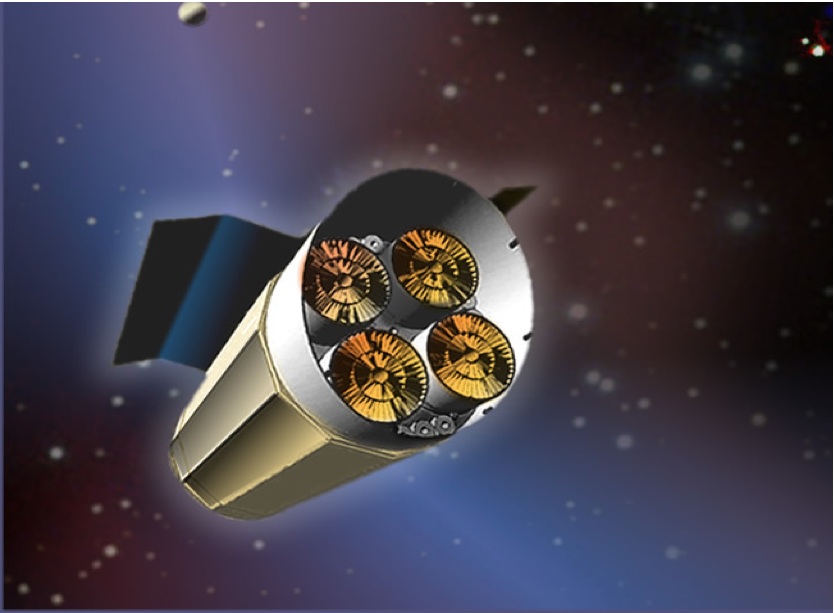
Howell's research shows that the average Type Ia supernova was 12% brighter billions of years ago. Even if DE exists, a "Dark Energy Mission" would not return a single particle or even a track in a bubble chamber to prove it exists. All we would have is an "equation of state" that physicists could puzzle over and write papers about. The equation of state could be explained by changing parameters, like the speed of light. The high precision required for an equation of state requires that supernovae be constant. The Howell paper is in Astrophysical Journal v. 667, p. 37 Do taxpayers really want to spend 1 billion+ US for this?
As someone writes in Quantum Diaries:
"Inferences of cosmic acceleration depend on many other values being constant, including luminosity of supernovae. Many values have changed in the billions of years since distant stars exploded. The metal content of ancient stars is known to have been much less than today. Since we cannot time-travel into the past, it is difficult to determine if fundamental values are constant."
Many quantities that were once thought constant have been found to change. Even the output of science is not constant--it proceeds in fits and starts. Advances are slowed by dogma and accelerated by revolution. We may find that the only constant is change. It is best to give science its opportunity to advance.
This week Space for Commerce hosts the Carnival of Space!
Labels: astronomy, dark energy, physics
Sunday, September 30, 2007
Radio Burst

Today's information age allows some astronomy to be done from a desktop. Projects like the Sloan Digital Sky Survey produce enormous databases. Sometimes, as was the case with WMAP, the data is jealously guarded so that the gatherers can impose their own interpretation. Ideally, all researchers are free to dig at their convenience. Sometimes mining old data can lead to a new discovery.
By searching archived data from 2001, radio astronomers have uncovered a powerful new type of radio burst. The original survey examined the Small Magellanic Cloud for repeating bursts of pulsars. The 2001 survey missed this burst, which lasted only 5 milliseconds. Because of its offset location, the burst is interpreted to come form far away, 3 billion light years. the discovery was reported in the September 27 issue of Science Express.
Source of this burst is still a mystery. Many scientists have theorised that intergalactic Space is full of unseen objects like Black Holes. Normally invisible, Black Holes would occasionally evaporate in brief bursts of radiation. The death of a Black Hole would look very much like this.
This week Carnival of Space looks at the art of Space.
Labels: astronomy
Wednesday, September 05, 2007
LISA and JDEM

Supernova SN 2006dr in galaxy NGC 1288 photographed by the European Southern Observatory's Very Large Telescope (VLT). On the night of July 17, 'amateur' astronomer Berto Monard discovered this Type Ia supernova from South Africa. NGC 1288 is 200 million light-years away. The supernova is the bright spot to the left of the galactic centre. Observations of distant Type Ia supernovae have led to the inferrence that the Universe is accelerating relative to the speed of light. ESO Press Release
The committee of the National Research Council has selected two Beyond Einstein missions to take advantage of a funding wedge beginning FY 009. Of the Einstein Great Observatories, the Laser Interferometer Space Antenna was selected over Constellation-X. Of the smaller Einstein Probes, a Joint Dark Energy Mission is seen to have the highest priority.
The committee concluded that NASA alone can not provide funding for these missions. Key to the decision was the expected involvement of other agencies, DOE for JDEM and ESA for LISA. NASA's next priority is to select one of the candidate JDEM missions for further funding. There will be continuing funding challenges in the era of the Moon, Mars and Beyond. Solving the 'dark energy' problem is seen to be the most profound mystery in science.
Labels: astronomy, dark energy, physics
Monday, September 03, 2007
Not Dark Energy
The speculation called "dark energy" is subject of more questions in NEW SCIENTIST, Swiss cheese universe challenges dark energy.
"Dark energy may not be needed to explain why the expansion of space appears to be speeding up. If our universe is like Swiss cheese on large scales – with dense regions of matter and holes with little or no matter – it could at least partly mimic the effects of dark energy, suggests a controversial new model of the universe."
As nige has noted, if the Universe is not homogeneous different regions will appear to expand at different rates. If your telescope looked in a direction of lower expansion, the Universe would appear to be accelerating. This adds to many anisotropies seen in the Cosmic Microwave Background. Though this model is very preliminary, physicists Sabino Matarrese and Rocky Kolb have published online On cosmological observables in a swiss cheese universe.
Back in March, NEW SCIENTIST published Is dark energy an illusion?
"The quickening pace of our universe's expansion may not be driven by a mysterious force called dark energy after all, but paradoxically, by the collapse of matter in small regions of space."
Just last week A Hole In the Universe indicated that the Universe is not quite homogeneous, and a cosmology including "dark energy" may be all wrong. The proposed Supernova Acceleration Probe would survey only 15 square degrees of sky before ending its service life. The whole sky has an area of 41,253 square degrees! If SNAP looked at the wrong part of an inhomogeneous sky, it could give researchers the wrong value of cosmic acceleration. Then again, disciples of "dark energy" may already have the wrong idea.
Lawrence Krauss said that supernova data "naively implied that the Universe is accelerating." The inferrence of cosmic acceleration relies on a daisy chain of assumptions, including homogeneity. It especially relies on assumption of a constant speed of light. SNAP/JDEM is subject to a review whose results will be announced Wednesday. With all the outstanding questions about its basic science, it is hard to see how SNAP can supersede projects like Constellation-X.
"Dark energy may not be needed to explain why the expansion of space appears to be speeding up. If our universe is like Swiss cheese on large scales – with dense regions of matter and holes with little or no matter – it could at least partly mimic the effects of dark energy, suggests a controversial new model of the universe."
As nige has noted, if the Universe is not homogeneous different regions will appear to expand at different rates. If your telescope looked in a direction of lower expansion, the Universe would appear to be accelerating. This adds to many anisotropies seen in the Cosmic Microwave Background. Though this model is very preliminary, physicists Sabino Matarrese and Rocky Kolb have published online On cosmological observables in a swiss cheese universe.
Back in March, NEW SCIENTIST published Is dark energy an illusion?
"The quickening pace of our universe's expansion may not be driven by a mysterious force called dark energy after all, but paradoxically, by the collapse of matter in small regions of space."
Just last week A Hole In the Universe indicated that the Universe is not quite homogeneous, and a cosmology including "dark energy" may be all wrong. The proposed Supernova Acceleration Probe would survey only 15 square degrees of sky before ending its service life. The whole sky has an area of 41,253 square degrees! If SNAP looked at the wrong part of an inhomogeneous sky, it could give researchers the wrong value of cosmic acceleration. Then again, disciples of "dark energy" may already have the wrong idea.
Lawrence Krauss said that supernova data "naively implied that the Universe is accelerating." The inferrence of cosmic acceleration relies on a daisy chain of assumptions, including homogeneity. It especially relies on assumption of a constant speed of light. SNAP/JDEM is subject to a review whose results will be announced Wednesday. With all the outstanding questions about its basic science, it is hard to see how SNAP can supersede projects like Constellation-X.
Labels: astronomy, dark energy, physics
Friday, August 31, 2007
Crashing the Gates

"Even the smallest person can change the course of the future."
GOAL: This experiment tests whether one person can affect the course of science. PROCEDURE: The academic year 2006-2007 might have been more comfortably spent on the beach in Waikoloa or Queensland. Presentations were made at multiple meetings. Except for one missed appointment in the UK (which doesn't affect US science policy) they went well. Along the way we found other people, even big people, who had been seeking change all along. This entry is limited to physics meetings in which the writer spoke or gave a presentation.
COSMO 06 September 25-28 also heard from physicist Michael Turner. Though often credited with coining the term "dark energy," Turner is open to adopting better ideas. His highlights: 1) The highly-touted "precision cosmology" depends on priors. 2) Measuring the gears is not the same as understanding the machine, 3) We are "over-invested" in string theory (Lisa Randall was there too) and inflation, 4) There is no Plan B for cosmology. The top of his list of ideas that need to be investigated: VARYING CONSTANTS.
Both this meeting and the AAAS meeting in February were very convenient to the SNAP collaboration. At COSMO, SNAP was represented by just a single junior researcher. The poor woman was so short of funds that she went about asking for a ride back to Berkeley. They didn't show their faces at all during AAAS. Is the mighty SNAP running low on petty cash?
AAS High Energy Astrophysics Division October 4-7 heard Chief Scientist Harvey Tananbaum point out that Constellation-X is considered the next priority after the James Webb Space Telescope. He didn't badmouth human spaceflight, but showed ways to carry CON-X in the Atlas V booster. He also reminded us that CON-X and LISA are NASA-approved programs, unlike SNAP/JDEM.
2 years earlier KIPAC's Roger Blandford had been corralled into giving a public talk on "dark energy." In a meeting full of CON-X supporters, Blandford diplomatically avoided mentioning DE. He urged us to attack fundamental problems directly, instead of "assumption-fitting model-building." He called the current physics "epicycles."
American Geophysical Union December 11-15 was full of scientists studying practical matters like Earth's climate. "Hot Young Solution to Faint Sun Paradox" was accepted for its contribution to climate science. Interest in this planet has led to great benefit, which I hope to write about soon.
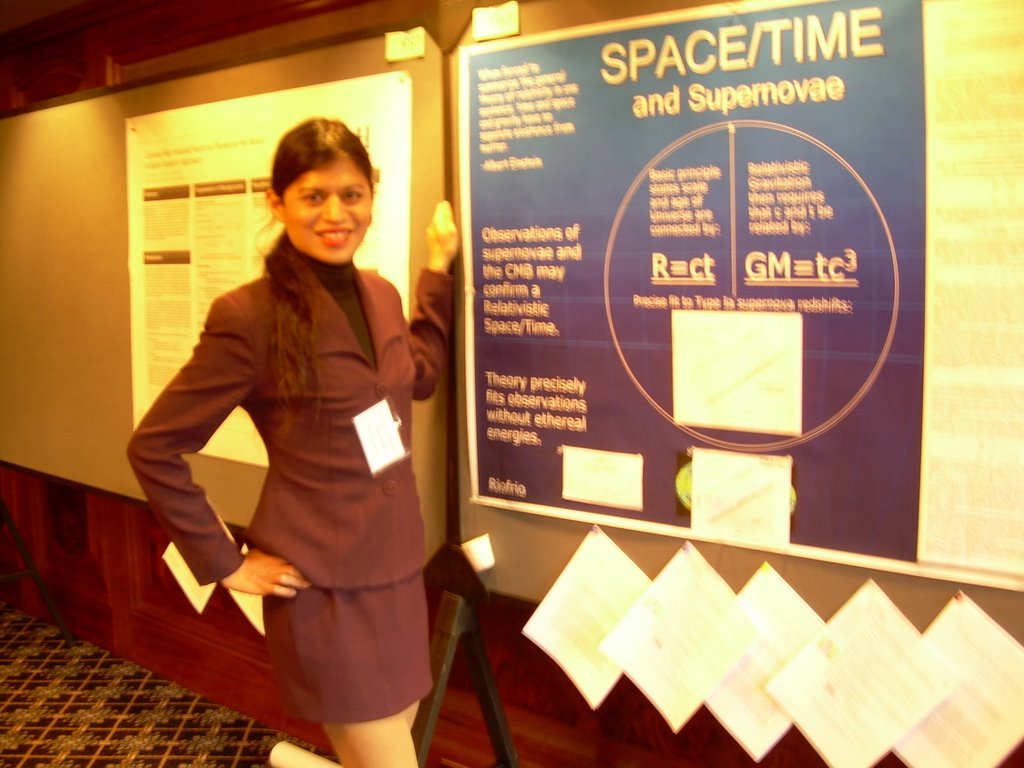
NRC Town Hall February 1 heard comments from this writer (picture below) that were echoed in the journals as Why Dark Energy Is Bad For Astronomy. Shortly they will announce the important decision as to which "Beyond Einstein" mission will fly. It also gave one a good excuse to see Disneyland!
GLAST Symposium February 5-8 saw Roger Blandford again avoid mentioning "dark energy." One of the first issues he did mention was "Violations of Lorentz Invariance," or a changing speed of light. He said that once Lorentz violations are discovered, other researchers will claim that they knew it all along. Thanks for seeing my presentation, Dr. Blandford!
CONCLUSION: Academic year 2006-2007 saw signs of a "c change" in physics. As with previous paradigm shifts in science, much depends on the individual. Seeking and joining with other individuals can have enormous effect. Many photographs and direct quotes from others have been included to show that "c change" is a real phenomenon. Regardless of the outcome, this has been an adventure which one would not trade for anything.
UPDATE: The National Academies are due to release an important decision September 5, 2007 at 4 PM EST. Have a nice weekend! Check out the new Carnival of Space!

Labels: astronomy, cosmology, physics, speed of light
Wednesday, August 29, 2007
Beyond Einstein Decision

One week from today is September 5th. At 4 PM EST, the National Research Council will release their report "NASA's Beyond Einstein Program: An Architecture for Implementation." The report is intended to decide which of the five proposed missions (Constellation-X, Laser Interferometer Space Antenna, Joint Dark Energy Mission, Inflation Probe, and Black Hole Finder probe)will fly first. Regardless of the future, this writer is very grateful for the purple BEYOND EINSTEIN pen, which is all a theorist really needs.
Constellation-X is subject of a profile in August's issue of Physics Today. The article points out that the National Academies 2001 Decadal Survey named CON-X as a priority second only to the James Webb Space Telescope. "Constellation-X will also be able to use galaxy clusters to investigate the nature of dark energy with an accuracy comparable to supernova-based studies;" the article contnues, "thus it will also complement ground-based dark energy surveys."
At AAS HEAD and other meetings were hundreds of high-energy astronomers eager to see CON-X launch. Support for JDEM/SNAP is limited to a few physicists based mostly in Berkeley. It is no exaggeration to say that the leadership of SNAP team are not astronomers, but have all their training in physics. Getting a job in particle physics is hard, and "dark energy" allows a way to take astronomy funding. It has also allowed a way to adopt particle physics work habits--big experiments, big collaborations, big budgets, and conclusions based on groupthink. This is how the whole idea of "dark energy" got started.
If JDEM someday flies it will not return a single particle of "dark energy," just an equation of state. This can be found using JWST or other experiments. Even if repulsive "dark energy" exists, it would be so diffuse in Space that it could not power a cell phone. It has not led to a coherent theory, only an endless divergence of speculations. Physicists have been busy crowding the journals with specualtion about "dark energy."
Depending on decisions, pursuit of "dark energy" could delay other missions by years. Even if DE exists, it has no practical use. It will not even lead to a coherent theory, only endless speculation. All of those who read this, is "dark energy" good for science?

