Sunday, October 23, 2011

The Capitol Dome


The entrance to our hotel in Washington is in sight of the Capitol Dome. Something is universal about the spherical shape. Domes have been part of human architecture for thousands of years. The architecture of our bodies is full spherical cells. Moons, planets, stars and even raindrops form spherical shapes. Many great thinkers have thought that the Universe itself is spherical.

Blaise Pascal, one of the great mathematicians of all time, thought the Universe was spherical. "Nature is an infinite sphere of which the center is everywhere and the circumference nowhere," wrote Pascal. Edgar Allen Poe, who lived near here in Baltimore, also thought the Universe was spherical. The spherical Universe was subject of Poe's EUREKA, a prose about cosmology. Among all his great works of poetry and fiction, Poe was most proud of the little-known EUREKA.

Most prescient, Poe suggested that this spherical universe expanded from a tiny point! "From the one particle. as a center, let us suppose to be irradiated spherically--in all directions--to immeasurable but still to definite distances in the previously vacant space." 75 years later Alexander Friedmann, who was a big Poe fan, also predicted an expanding Universe.

Einstein realized that if the Universe contained enough mass, gravity would bend it into a sphere of four dimensions. He also realized that gravity would also cause the sphere to collapse, unless it were already expanding. Einstein then added a repulsive "cosmological constant" to prevent collapse. Later, when Edwin Hubble's observations showed that the Universe was expanding, Einstein considered the CC his greatest blunder.

Today it is fashionable for cosmologists to say that our Universe is flat, like the Earth. If you question cosmologists, they will first ignore you but then admit that on the large scale it must be spherical. If the Universe expanded from a tiny point, it is topologically impossible for it to be flat. The exponential expansion called inflation would have expanded the sphere so much that it would appear flat to our observations. On the largest scales, the Universe must still be spherical.

The beauty of the Capitol dome reminds us that the spherical shape is universal. Applied to the Universe, great thinkers like Pascal, Einstein and Poe considered our Space/Time to be spherical. Edgar Allen Poe made amazing predictions like an expanding universe. Einstein first proposed a cosmological constant, then considered it a great blunder. Though it is fashionable to say the universe is flat, fashions change with time.

We finish the meeting with a banquet at the Rayburn Senate Office building, close to the Capitol. As the spherical Sun disappears behind the curve of a spherical Earth, we are reminded how universal the sphere is.

Labels: ,

Saturday, October 22, 2011

Udvar-Hazy


The National air and Space Museum on the Washington Mall is a huge building, so big that a Skylab Space Station occupies just one corner. Even this structure can not contain the whole collection, so the larger aircraft are displayed at the Stephen F. Udvar Hazy center near Dulles Field. In the last post we saw the test vehicle Enterprise in a place of honour for Space Shuttles. The B-29 Enola Gay gives some idea of the scale of this building.

Even in this bigger space, the Concorde SST is a tight fit. From a high catwalk, it is difficult to get the whole plane in one shot. In its heyday Concorde regularly carried passengers at cruise speed of Mach 2. It could not travel faster, due to the effects of heat on an aluminum airframe. The cancelled Boeing SST would have been even bigger, 90 meters long. Planned to be built of lighter heat-resistant titanium, America's SST would have cruised at Mach 3. What would airports look like if these giants had survived?

Sustained flight at Mach 3 had been proven practical in the 1960's by this aircraft. Fitting for a plane that travelled to the edge of Space, the SR-71 Blackbird has a choice location in front of the entrance to the Space Hall.

Enterprise is not the only historic object in the Space Hall. The Astronaut Quarantine Facility housed the Apollo 11 crew on their return to an aircraft carrier. Prior to their mission, no fresh samples had ever been returned from the Moon. Scientists were not completely sure that the Moon was lifeless, and there was some fear of an ANDROMEDA STRAIN contagion. After the first Apollo missions and their samples had returned, the science community finally concluded that there were no Moon bogs.

In another corner is the miniature Mothership from CLOSE ENCOUNTERS OF THE THIRD KIND. Like our Space Station, it appears to be assembled from cylindrical modules. Something is universal about the circular shape. We can only imagine what sort of propulsion systems would drive a craft like this to the stars. Hopefully the Smithsonian will someday display a real starship.

My photo of Enterprise headlines the new Carnival of Space!

Labels: ,

Tuesday, October 18, 2011

Enterprise


The Udvar-Hazy center of the National Air and Space Museum, close to Dulles Airport, is home to the test vehicle Enterprise. During the 1970's Enterprise was drop-tested from a 747 as preparation for the Shuttle program. Last week, in The Latest from NASM, we saw the original Starship Enterprise miniature on display by the Washington Mall. The name Enterprise was the result of a letter-writing campaign by thousands of STAR TREK fans. At the end of the Shuttle journey, we can think about the future.

Presently this room is slated to be taken over by the Shuttle Discovery. Enterprise would then be transferred to the Intrepid Air Space museum in New York City. The Intrepid is just a 4.5 hour drive from Washington, and the choice leaves the middle of the US without a Shuttle. Space Center Houston and the Air Force Museum in Dayton, who were not awarded Shuttles, are quite unhappy with the choice. Sadly, even on Earth there are not enough Shuttles to go around.

Beneath Enterprise's port wing is a small display case with early Shuttle concepts. Originally the system was envisioned as being fully reusable. A winged first stage would glide back to Earth after each launch, to be refueled and used again. The configuration finally built, with solid rocket boosters and an expendable tank, was less expensive to develop but had much higher operating costs. As this system was being built, NASA envisioned 50 flights per year. Such a flight rate proved to be impractical. The dream of a fully reusable Space Transportation System has still not been realized.

As we heard from Elon Musk in Washington, SpaceX is planning a fully Reusable booster. His concept is different, with wingless unmanned boosters automatically returning to land vertically. Elon claims that the fully reusable concept could reduce launch costs a hundredfold. We can wish him the best of luck.

We are able to economically travel to Washington DC because of reusable aircraft. Most of the denizens of the Air and Space Museum, from the Wright Brothers' plane, were designed to be used repeatedly. The Starship Enterprise of the future is, like a Navy ship, fully reusable. The Enterprise design that sits in Udvar-Hazy is the result of many compromises. An economical fully reusable Space Transportation System is still in the future.

Labels: ,

Friday, October 14, 2011

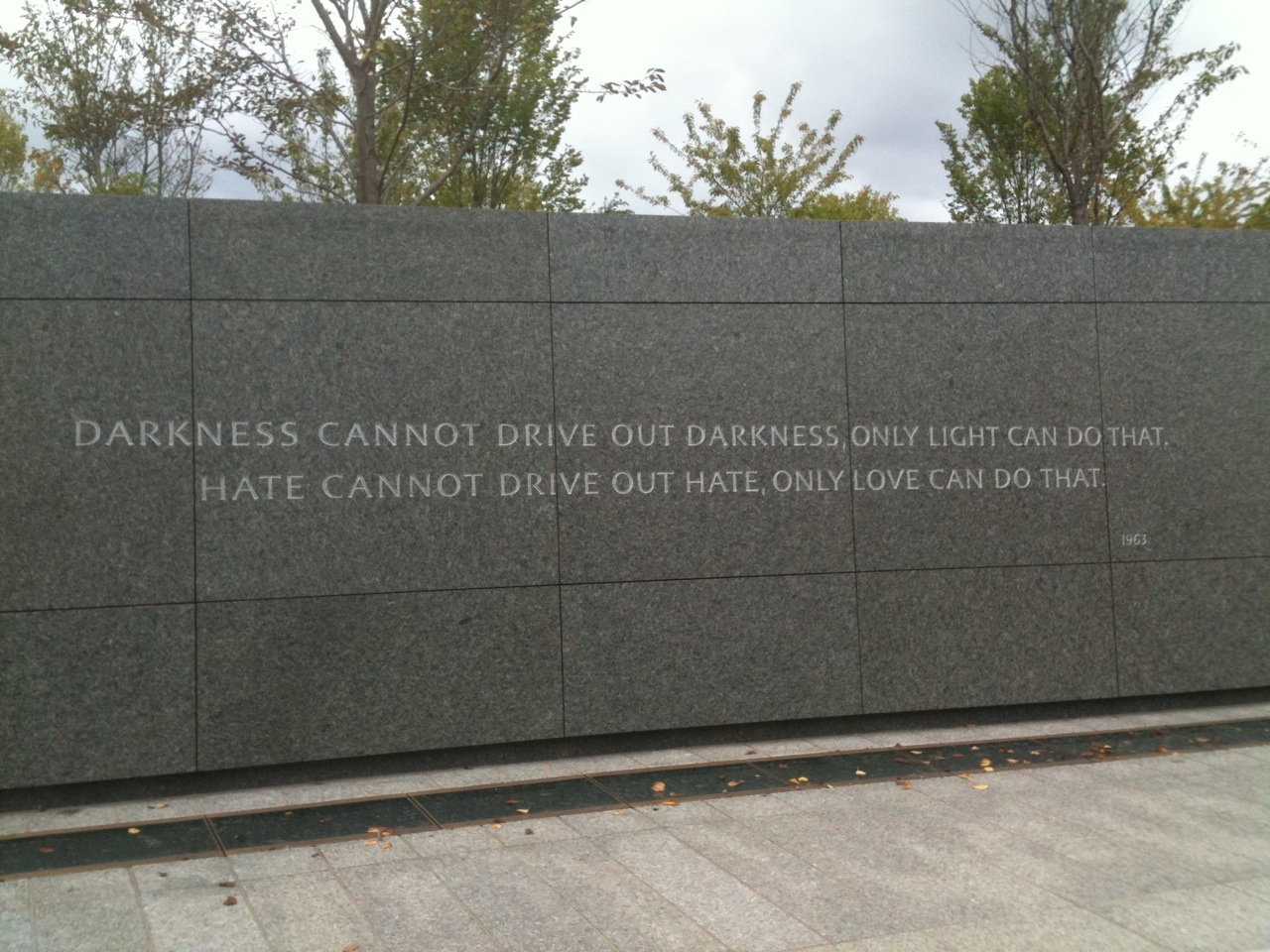
Darkness Can Not Drive Out Darkness


Another Nobel Prize Winner: This Sunday, October 16, Washington's Martin Luther King Memorial will be dedicated. The ceremony would have happened earlier, but the surprise earthquake in September caused postponement. Even the US Eastern seaboard is vulnerable to earthquakes and tsunamis. Because of the delay, we visitors to DC have been able to preview the monument. Behind a 30-foot King statue is a marble wall filled with his quotes. One of King's bits of wisdom could apply to physicists puzzling about "dark energies."

"Darkness can not drive out darkness, only light can do that."

The answer to apparent acceleration of the universe has not been found in hypothetical "dark" energies. Such speculations are rejected by the public and will harm the reputation of physicists. Redshifts of distant objects are roughly proportional to recession velocity divided by the speed of light, v/c. The non-linear redshifts of Type Ia supernovae, which just won its discoverers their own Nobel, is more plausibly due not to v accelerating, but to c slowing down. The answer to the mystery is not in the dark, but in light.

In 2009 the Nobel Peace Prize committee inexplicably rewarded a man with no record of peace, leading to much ridicule. This year's award goes to Liberia's President Ellen Johnson Sirleaf, Leymah Gbowee from Liberia, and Tawakkol Karman from Yemen. All three women have faced and continue to face formidable opposition. Karman, the first Arab woman to win the Prize, has been detained and harassed by mobs with clubs. Women who face such challenges deserve the Nobel Prize.

Labels: ,

Sunday, October 09, 2011

Latest from NASM


Saturday and Sunday we had a few Washington hours for another pilgrimage to the National Air and Space Museum. One week later, Saturday October 8, the entire museum was shut down due to protesters. Why would anyone want to protest this place? This is what the protest was allegedly about, a display of military drone aircraft. How many people travelled thousands of miles to have their museum plans disrupted? We suspect that the demonstrators were unhappy with US policy. There is plenty to be angry about, but such protests belong at the White House.

A room devoted to the Wright Brothers' achievements. NASM is Washington's most popular attraction, a place devoted to our universal fascination with flight. The aircraft and displays here are beyond priceless. Among them are Russian spacecraft and Axis warplanes from WW2. The machines are fascinating, regardless of the policies they were tools of.

This is not a mockup, but a spaceworthy Skylab 2 built to be flown after Skylab 1. Though it makes a fascinating exhibit, what a waste to be not flown in Space. Could we make a similar mistake again? Some say that the Space Shuttle orbiters have many useful flights left, and should not yet be put in museums.

The USS Enterprise from the classic STAR TREK series is presently in the basement of the souvenir shop, among the bargain items. The Enterprise Space Shuttle test vehicle is at the NASM Udvar-Hazy museum near Dulles airport. Space will always be central to humanity's dreams for the future.

Labels: ,

Locations of visitors to this page